
Florida County Saves Millions by Building its own Broadband Network
We have been following the Gig.U initiative, the collaborative effort between 30+ U.S. leading research universities. Their mission is to quicken the deployment of high-speed networks to universities and their surrounding communities to improve innovation, research, collaboration, and economic development. This week, the University of Florida announced they will be working with Gainsville's GRUCom, and GigU to bring fiber to homes and businesses near the Gator campus.
The area, known as Innovation Square, is a 12-block area between the UF campus and downtown Gainesville. The initiative will offer connections to residences for an introductory price of $99 plus tax. Connections within the district will be as fast as 1 Gps while connections to users and websites outside the network will be 50 Mbps. Business rates will be determined on a case-by-case basis. While the gigabit connection may be too expensive for many in the area, the infrastructure will be in place when gigabit costs drop.
From the University of Florida News:
“Entrepreneurs and technology leaders work in a competitive world where big ideas and enormous amounts of information need to move quickly,” [UF President Bernie] Machen said. “This is just what’s needed to attract those types of people to the Innovation District. Having a high-bandwidth community near our campus creates an environment that will better serve the mission of educating our students and creating a hub of high-tech economic growth for Florida.”
GRUCom is the telecommunications division of Gainesville Regional Utilites, owned by the City of Gainesville. In addition to providing telecommunications services, the utility supplies electricity, natural gas, water and wastewater services to 93,000 retail customers in the area. The GRUCom network includes 375 miles of fiber in and around Gainesville and delivers Internet, data transport, colocation, cellular carrier and wireless, and public safety radio services.
UPDATE:
GRUCom informs us that the fiber build out will belong to GRU and the City.
The Coalition for the New Economy — which works to ensure “that investments in broadband networks are used efficiently and effectively”— wrote Tuesday that “funding for government-owned broadband networks is very often duplicative,” and “diverts local funds from public safety and education. ... Christopher Mitchell of Community Broadband Networks tells the Independent that official U.S. government policy believes “we can have proper competition if every competitor builds their own network, and that is not at all supported by reality.”This group is emphatically supporting less competition because the private sector does not want to overbuild other private networks. If the public is not allowed to build next-generation networks where private companies already operate last-generation networks, communities will have neither modern connections nor real choices. The cable and DSL companies are arguing that no one should be allowed to build public interstates where private dirt roads exist. We live in a democracy. We are supposed to be free to choose the best policies in promoting infrastructure. We can choose a future where we are more dependent on a few absentee massive corporations or one in which we have more control over our future. We can pursue policies that would result in real choices among broadband service providers or we can continue the status quo, where choices dwindle. Below, I have included an excellent debate from last year in which the above points are fleshed out over 2 hours.
Building a new network requires a massive up-front capital investment - in this case the city will have spent $4.4 million to connect the first connection. Good thing they aren't all that expensive!
The article identifies two main sources of the delays: difficulty in getting on the poles owned by Progress Energy and long delays in receiving the fiber-optic cable they ordered (stimulus projects have hogged the supply). Rather than taking 12 weeks, they had to wait 30. Delays cause problems:
The installation delay has put the city in a pinch with its lender, Regions Bank.
Martin County, Florida, is building a county-owned network (that we wrote about back in September) in response to gross overcharging by Comcast for the connections they need to connect their City Departments.
The County Commission voted unanimously Tuesday to allocate $100,000 to pay experts to advise county officials about ways the new broadband network the county government is constructing could be used to generate revenue as well as promote economic development and job creation.
...
Precision Contracting Services of Jupiter started construction on the $4.2 million network in January and is expected to finish the project by January 2012. The network is expected to serve 280 government, public safety, educational and health care organizations.
Having committed to building a network to meet their own needs, they are now searching for ways to leverage that investment to best meet community needs. They will evaluate laws, conduct a survey of residents and businesses to find what their needs/desires are, and possibly develop a business plan.
Last Monday, the day before the planned vote, a Comcast regional VP had the gall to ask the County Commissioners to delay their vote. No thanks Comcast, these folks have waited long enough for the broadband they need, that you have no interested in delivering in a timely nor affordable manner. On Tuesday, the Council voted unanimously to approve the contract.
Good for them.
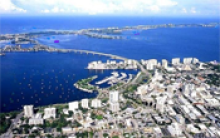
The report lays out a range of options for the city: from doing nothing and letting the market determine Sarasota's broadband future; to partnering with a private entity in building a network that would increase speeds; to tapping a public project already in the works that could create a powerful Internet backbone between Manatee and Sarasota counties.We recently reported on another community, Dunnellon, that is building a community fiber network. Unfortunately, these communities have to deal with unnecessary barriers created by the Florida Legislature as they invest in the future of their community. Photo used under Creative Commons License, courtesy of 83d40m
The City Council voted unanimously Monday night to approve the $7.3 million in funding with Regions Bank in Orlando. City Manager Lisa Algiere told the council members the city would be doing most of its business with the local Regions Bank. The funding will come in the form of three bonds: a series 2010A Bond, which is good for 20 years and has an interest rate of 3.61 percent; the second bond is a Series 2010B Bond and is for five years with an annual interest rate of 3.20 percent; while the third bond is a Series 2010C Bond and is good for one year. The funding secured by the city is a drawdown loan, meaning it will only take what it needs and only repay that portion.The network has been branded Greenlight (though the website is not yet fully functional). Greenlight is also the name used by the Community Fiber Network in Wilson, North Carolina. Light Reading interviewed a network employee, shedding more details than have been released elsewhere. He says they are passing 7,000 premises, but Wikipedia only notes a population of 2,000 in 2004, so there is more than meets the eye at first glance. They financed the network without using general obligation bonds, working with a nearby bank (Regions is a big bank, headquartered out of state). Local competitors are AT&T and Comcast, though both offer extremely slow services; the fastest downstream speed available from Comcast is 6Mbps. The new network, as do nearly all recent community fiber networks, will offer much faster connections, the slowest being 10Mbps.
Reliability is a good economic development tool, he said. One business looking at Chattanooga asked about the cost of a redundant feed. After EPB explained its smart grid plans, the company chose Chattanooga and decided it didn’t need a redundant feed, he said. In talking to businesses, "I can tell you ... that they get it and they get the importance of this level of automation."The article offered more details about Ponca City's wireless network that we had previously not discussed. In addition to offering free Wi-Fi to residents, the Ponca City offers fiber-optic-based broadband to local businesses... and two are quite connected.
Perhaps the most eye-opening benefit is that Ponca City offers all of its 26,000 citizens free WiFi service. The city uses its fiber network to sell broadband services to businesses (one has requested 300 mbps service) and those sales pay for the free WiFi, Baird said. The network is basically support-free, said Baird, adding that he gets one or two calls per week. And the free WiFi is "a huge economic development draw," he said.
Green Tech Grid asks, "Are Munis and Co-Ops Leading Smart Grid?" And the rest of the article says, "YES." This should come as no surprise for readers of this site. The dynamics, and even players, in smart-grid are very similar to those of community networks. There are essentially two approaches to smart-grid: that of the investor-owned utilities that see smart-grid investments as an opportunity to raise rates, and that of munis and coops who see an opportunity to cut costs and better serve their ratepayers.
In Leesburg's case, they knew that just an advanced meter deployment would cut their cost. "We told our commission we're not going to increase our rates because we're rolling this out," said Paul Kalv, Electric Director of Leesburg Power. "And we know we'll be reducing the customer charge to share those savings." So far the city has saved about $1 million. Kalv talks a lot about his customers. When one guy complained about his smart meter, Kalv personally went over to his house to check it out. It is that sort of on-the-ground interaction that is simply not possible for the CEO of investor-owned utilities, like Florida Power & Light Company, where Kalv worked for 22 years.
I raise this issue to note that the article discusses Leesburg and Lake County, Florida, without mentioning their investments in broadband. But when Leesburg applied for the Google Gigabit project, they noted their fiber-optic assets.