

I-Net Beginning to Blossom in Greenfield, WI
Greenfield city officials and school administrators recently agreed to cooperatively build a fiber-optic institutional network (I-Net). The Milwaukee suburb of about 37,000 expects to trim thousands of dollars from its annual network bill and bring its students, teachers, and local government up to speed.
Dig Now, Save Now
Just like many communities across the U.S., Greenfield realized that it was paying too much to connect its community anchor institutions (CAIs) to the Internet. In April 2015, Greenfield school district approved a bandwidth upgrade with a private provider that would cost the schools $45,588 annually. Within half a year, they had already hit their new bandwidth limit. In November 2015, they needed to upgrade again to the tune of $119,141 per year.
With classrooms and public institutions demanding increasingly higher bandwidth, local officials decided to ditch the incumbent providers to build a fast, affordable, reliable network in the coming semester. Their investment will allow them to make long-term budgeting decisions, direct more money toward classroom expenses, and use technology to offer rich educational experiences.
Construction started in June on the fiber-optic network that will connect Greenfield school district, neighboring Whitnall school district, Alverno College, and Greenfield public safety buildings. With installation slated to finish by summer’s end, local institutions expect immediate savings.
Financial Terms
The City of Greenfield, Greenfield School District, and Whitnall School District all applied for state trust fund loans through the Board of Commissioners of Public Lands of Wisconsin (BCPL).


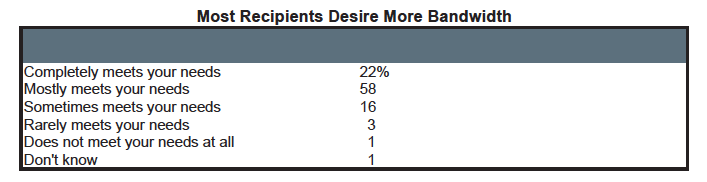 The question is why they want faster connections. Only 20% say their current connection completely meets their need to conduct online testing and assessment applications - with another 44% saying it "mostly" meets those needs.
 These gaps represent a tremendous opportunity for growth - communities should be building their own fiber-optic connections to connect these key institutions and ensure they will have affordable, fast, and reliable connections well into the future. By owning the network, these institutions will have greater control over future costs and their capacity to take advantage of even newer applications.
The FCC should favor locally owned networks to encourage self-reliance instead of never-ending subsidies to private carriers who have little incentive to lower prices and increase investment.
These gaps represent a tremendous opportunity for growth - communities should be building their own fiber-optic connections to connect these key institutions and ensure they will have affordable, fast, and reliable connections well into the future. By owning the network, these institutions will have greater control over future costs and their capacity to take advantage of even newer applications.
The FCC should favor locally owned networks to encourage self-reliance instead of never-ending subsidies to private carriers who have little incentive to lower prices and increase investment.
