
Los Angeles County, California

Content tagged with "Los Angeles County, California"

Parent
Displaying 1 - 10 of 18

California Greenlights Another $18.2 Million For Affordable Broadband
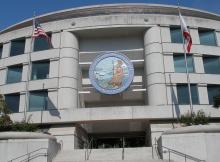
California and the California Public Utilities Commission (CPUC) continue to heavily invest in state efforts to expand affordable Internet access, and bolster digital equity, inclusion, and education programs to ensure freshly-connected communities are able to make the most of it.

According to a new announcement by the CPUC, the agency has freshly approved $14.7 million in California Advanced Services Fund (CASF) Broadband Infrastructure Grant Account funding for four fiber-optic broadband projects in rural Northern California.

The agency says it approved another $3.4 million in CASF Rural and Urban Regional Broadband Consortia grants supporting broadband planning and coordination efforts across 16 counties, and nearly $200,000 in Digital Divide Grant Program funding to expand access to technology, devices, and digital literacy training in underserved communities.

The state’s latest $18.2 million in digital literacy and access grants are one small part of California’s landmark $6 billion Broadband for All Initiative, which prioritized closing the digital divide in all of California’s 58 counties, and recently culminated in the launch of the state’s new $3.2 billion Middle-Mile Broadband Initiative (MMBI).

The CPUC states that its $14.7 million in CASF broadband infrastructure grants will be doled out to Plumas-Sierra Telecommunications – a wholly owned subsidiary of Plumas-Sierra Rural Electric Cooperative (PSREC) for four projects around the Golden State. Plumas-Sierra Telecommunications will own the finished networks across all four projects:
Antelope Valley, California Eyes $24 Million Fiber Expansion

Antelope Valley, California officials are hoping to leverage California’s historic recent round of broadband grant programs to deliver affordable fiber access to a significant swath of long-underserved southern California desert communities.

According to Antelope Valley officials, they’ve applied for a $24.3 million California Advanced Services Fund (CASF) Broadband Infrastructure grant to help them deliver symmetrical 10 Gigabit Passive Optical Network (XGS-PON) technology to 988 total households, most of which would be seeing affordable fiber access for the first time ever.

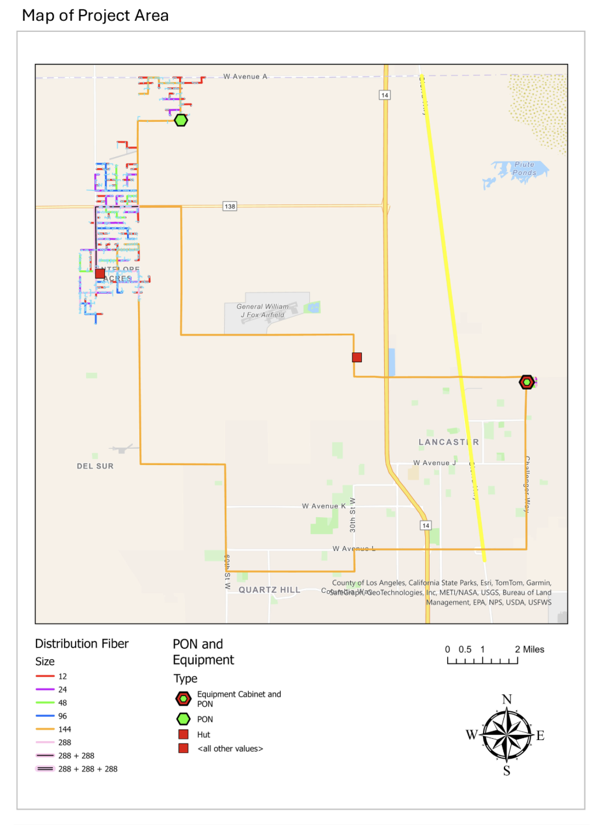
A breakdown of the project included in the application submitted by the Antelope Valley Union High School District to the California Public Utilities Commission (CPUC), indicates that the proposed project seeks to connect to the California State Middle Mile route at two points currently being negotiated in collaboration with state Middle Mile Authorities.

“The award will not be determined until approximately quarter two of next year,” Antelope Valley Union High School District Superintendent Greg Nehen tells ILSR.

Image
Antelope Valley fiber project map

The Antelope Valley Broadband Project would be constructed with 100 percent underground fiber installation, with all fiber-optic cables placed in buried conduit within public rights-of-way, using underground microducts, handholes, and splice enclosures. No aerial deployment is planned for this project, according to project leaders.

California Announces Another $207 Million In Last Mile Broadband Grants

California’s $2 billion Last Mile Federal Funding Account Grant Program (FFA) has announced another $207 million in new broadband grants across Amador, Los Angeles, and Solano Counties.

The FFA program, part of a broader $6 billion California “Broadband For All” initiative, is aimed at boosting broadband competition and driving down costs statewide.

According to the state’s announcement, $61 million in new grants were awarded by the California Public Utilities Commission (CPUC) for five Last Mile FFA broadband infrastructure grant projects in Amador and Solano Counties, bringing affordable fiber Internet access to approximately 10,000 Californians.

Image
Vallejo CA welcome sign

The CPUC award details indicate that the grants will be awarded to the Golden State Connect Authority (GSCA) and the City of Vallejo to help bring fiber access to 2,278 unserved locations in Amador and Solano counties.

The City of Vallejo will leverage $3.8 million in state grants to complete four different projects laying predominantly underground fiber, with the city retaining ownership of the finished network and Smart Fiber Networks providing last mile consumer-facing service.

Bridging the Digital Divide in LA County - Episode 608 of the Community Broadband Bits Podcast

In this episode of the podcast, Chris speaks with Eric Sasaki, Manager of Major Programs for the Internal Services Department at the County of Los Angeles. They delve into the ambitious efforts by Los Angeles County to address digital equity and broadband access for its diverse and populous communities. 

Eric shares insights on the county's vision for solving the digital divide, highlighting the historical context of infrastructure investments, the impacts of the COVID-19 pandemic, and the strategic use of federal funding from the CARES Act and the American Rescue Plan Act. 

The discussion covers the county's innovative approaches, including the deployment of community wireless networks and the importance of public-private partnerships. Eric also emphasizes the county's commitment to affordability, multilingual support, and collaboration with cities and community-based organizations. 

Tune in to learn about the significant strides being made to ensure quality, affordable internet access for all residents of Los Angeles County.

This show is 38 minutes long and can be played on this page or via Apple Podcasts or the tool of your choice using this feed.

Transcript below.

We want your feedback and suggestions for the show-please e-mail us or leave a comment below.

Listen to other episodes or view all episodes in our index. See other podcasts from the Institute for Local Self-Reliance.

Thanks to Arne Huseby for the music. The song is Warm Duck Shuffle and is licensed under a Creative Commons Attribution (3.0) license

Destination Crenshaw Breathes Life Into 'Open Air Museum' and Emerging ‘Digital Equity Zone’

On a map, the Crenshaw District is a 2.9 square-mile neighborhood in South Central Los Angeles, home to nearly 30,000 mostly black residents.

In the popular imagination, Crenshaw is the backdrop for the Oscar-nominated movie "Boyz In the Hood" – the real life neighborhood that cultivated the likes of former Los Angeles Mayor Thomas Bradley; rappers-turned-actors Ice Cube and Ice T; and the late rapper/entrepreneur Nipsey Hussle.

But on the streets of Crenshaw, a transformative vision is unfolding – an initiative local leaders describe as “a reparative development project.”

The idea is to inspire and empower neighborhood residents with strategic investments rather than displace them through gentrification. The effort is being led by Destination Crenshaw, a nonprofit community organization established in 2017 to celebrate the history and culture of Black Los Angeles.

The most visible part of the vision is to create the largest Black public art project in the nation along Crenshaw Boulevard, the 1.3 mile spine of the neighborhood – or what Destination Crenshaw describes as an “open air museum” centered around “pocket parks” and a “comprehensive streetscape design” that will feature commissioned murals and sculptures from local Black artists.

Building for Digital Equity: Life After ACP Reprise

If you missed our most recent Building for Digital Equity Livestream – Life After ACP – the virtual event can still be seen in its entirety (below).

The entire event focused on the imminent end of the Affordable Connectivity Program (ACP) and featured a lineup of speakers who shared on-the-ground perspectives and approaches being adopted at the community level to deal with the broadband affordability crisis in the absence of the popular federal program that has served 23 million Americans since its inception two years ago.

As a bonus, we are sharing links to the speakers slide decks below.

The first of two lightning round speakers, Margaret Käufer – President of The STEM Alliance – gave an overview on the short and long-term work her organization is doing in upstate New York in the face of ACP’s demise. You can find her slide deck here.

The second lightning round presenter Jason Inofuentes – Program Manager for the Broadband Accessibility and Affordability Office in Albemarle County, VA – unveiled an ACP supplement program his office is pursuing and how they see things moving forward. Those slides are here.

The first of the main presenters – Monica Gonzales, Digital Equity Supervisor for Methodist Healthcare Ministries in Texas – gave an overview of what her faith-based nonprofit healthcare organization is doing to address affordable connectivity across the 74 county South Texas region served by MHM. Gonzales’ slides are here.

Speakers And Agenda Announced for #B4DE Livestream ‘Life After ACP’

Bringing together a nationwide cross-section of leading digital inclusion practitioners, the first Building For Digital Equity (#B4DE) livestream of the year is set to zoom in on the imminent end of the Affordable Connectivity Program (ACP).

Co-hosted by the ILSR's Community Broadband Networks Initiative and the National Digital Inclusion Alliance (NDIA), the popular (and free) virtual gathering will focus on “Life After ACP” – as the FCC continues to wind down the program with the $14.2 billion fund on track to run out of money by the end of April.

Set for March 20, 2024 from 3 to 4:15 PM ET, the lineup of speakers will share on-the-ground perspectives and approaches being adopted at the community level as they work to keep financially-strapped households connected beyond ACP.

While virtual seats for #B4DE fills up fast, registration is still open here.

Here’s the run-of-show:

NDIA’s Amy Huffman will set the table on where things stand with the ACP wind down process before two lightning rounds take center screen.

LA Leads Way In Push To Leverage FCC’s New Digital Discrimination Rules For Local Action

In the wake of the new rules issued by the Federal Communications Commission (FCC) to prevent digital discrimination, digital equity advocates from California to Cleveland are leveraging the new federal rules to spur local action.

In Los Angeles, city leaders have passed an ordinance to combat what advocates say are discriminatory investment and business practices that leave historically marginalized communities without access to affordable high-quality Internet. Similar efforts to mobilize communities and local officials are underway in Oakland and Cleveland.

In November 2023, the FCC codified rules to prevent digital discrimination, outlining a complaint process whereby members of the public can offer evidence of digital discrimination being committed by Internet service providers (ISPs). Though the FCC order does not outline local policy solutions, nor does it empower localities to carry out enforcement of the federal rules, it has the potential to open up conversations between local advocates and elected officials about new ordinances, stronger enforcement of existing ones, or public investment to facilitate competition and the building of better broadband networks.

Los Angeles First City in Nation To Officially Define Digital Discrimination At Local Level

The local organizing work behind the proposed ordinance in LA dates back to 2022 when digital equity advocates began to document inequitable broadband access across the county.

Digital Equity Advocates Say California Risks Bumbling Plan To Deliver Equitable Broadband

California digital equity advocates say that recent cuts to the state’s ambitious broadband deployment plan unfairly harm low-income and minority communities. And despite promises from state leaders that the cuts will be reversed, local equity advocates say the process used to determine which neighborhoods should be prioritized remains rotten to the core.  

In 2021, California state leaders announced a $7 billion, multi-armed plan to bring affordable, next-generation fiber to every state resident. A key part of the plan involved building a $4 billion statewide middle-mile open access fiber network designed to drive down the costs of market entry, improve competition, and reduce broadband prices.

At the time, California officials said “the statewide network will incentivize providers to expand service to unserved and underserved areas.” Groups like the EFF lauded the “historic” investment, likening it to bold, early efforts to ensure rural electrification.

But last May, California officials quietly announced they’d be making some notable cuts to the state’s affordable broadband expansion plan. Blaming inflation and rising construction costs, the state’s renewed budget called for a 17 percent reduction in planned broadband investment, on average, across the state.

Digital Equity LA Picket Urges CA State Senator to Pass AB 41

Chants for “affordable” and “quality Internet” rang through the corridors of Inglewood City Hall this morning.

The source of that sound came from members of the coalition known as Digital Equity LA who assembled to picket in front of State Sen. Steven Bradford’s Office, publicly calling for an “end to digital redlining” and for passage of Assembly Bill 41 (AB 41), also known as The Digital Equity in Video Franchising Act of 2023.

If passed as is, the proposed bill – which we wrote about previously here – would establish an equal access requirement, anti-discrimination provisions, and a process for the public and local governments to provide input on the franchise agreements governing how cable Internet service providers serve their communities.

Image
Digitial Equity LA Picket

Noting how nearly 98 percent of all broadband subscribers in the Golden State get Internet service through cable companies operating under DIVCA franchises, reforming the franchise law would help reform broadband access – which the coalition says is essential to address the digital divide across one of the largest metro areas in the nation.