
Longmont, Colorado

Content tagged with "Longmont, Colorado"

Parent
Displaying 1 - 10 of 86

How NextLight Became the #1 Internet Service Provider in the Country - Episode 12 of Unbuffered

Unbuffered Logo - Two text bubbles

In this episode of Unbuffered, Chris is joined by Valerie Dodd and Scott Rochat for a conversation about the history, growth, and continued success of Longmont's NextLight fiber network.

They begin with some recent recognition for NextLight, including being named the number one Internet Service Provider in the country, the top municipal ISP, the most recommended provider, and the highest-value provider according to customer surveys. Valerie reflects on the network's continued growth and why community support has become one of its greatest strengths.

From there, the conversation turns to the history of the network, from Longmont's early investment in fiber infrastructure to the community campaigns that helped secure voter approval for city-owned broadband despite significant opposition spending. Scott shares stories from the effort to build the network and how public support continued to grow over time.

Chris, Valerie, and Scott also discuss lessons learned along the way, including managing rapid growth, maintaining customer trust, planning for success, and avoiding common mistakes. They reflect on what it takes to build and sustain a community-owned network and why success requires both local leadership and long-term commitment.

The episode also explores NextLight's commitment to affordability and accessibility. Valerie explains how Longmont developed discounted service offerings, expanded support during the pandemic, and continued providing low-cost Internet options even after federal subsidy programs ended.

The conversation closes with a look at the network's financial position, including subscriber growth, debt repayment, and what comes next for one of the country's most successful municipal broadband networks. 

This show is 39 minutes long and can be played on this page or via Apple Podcasts or the tool of your choice using this feed

You can also check out the video version via YouTube.

Transcript below.

We want your feedback and suggestions for the show-please e-mail us or leave a comment below.

Listen to other episodes (formerly Community Broadband Bits) or view all episodes in our index. See other podcasts from the Institute for Local Self-Reliance.

Thanks to Whitedrift for the song Operator, licensed Creative Commons Attribution (3.0).

Longmont NextLight’s Affordability Program Picks Up Federal Slack For Low Income Locals

Since it first broke ground in 2014, Longmont, Colorado’s city-owned NextLight fiber network has won numerous awards and inspired countless communities nationwide. But the network, which recently expanded access to more than 28,000 area residents, is also trailblazing in another area: ensuring that fiber is affordable to low income, marginalized populations.

NextLight unveiled its locally-funded Internet Assistance Program (IAP) last year. The program provides low-income residents with a $25 discount off of NextLight’s already affordable fiber pricing. As a result, locals can receive symmetrical 100 megabit per second (Mbps) service for as little as $14.95 a month, and symmetrical 1 gigabit per second (Gbps) fiber for $45.

To apply, households must qualify for any of a number of existing federal programs, including the FCC’s Lifeline, Head Start, Medicaid-MSP or SLMP, Veterans or survivor’s pension, Section 8, WIC, food stamps, Federal Pell Grants, Supplemental Security Income (SSI), SVVSD Education Benefit, Temporary Assistance for Needy Families (TANF), or Food Distribution Program on Indian Reservations (FDPIR).

IAP was created to offset the collapse of the Federal Communications Commission's (FCC) Affordable Connectivity Program (ACP), which provided a $30 per month discount off of the broadband bills of low-income Americans. The program was summarily discontinued after Republicans in Congress refused to fund a program extension.

According to Longmont officials, not only is their IAP program available to a much broader qualification base, with more than 1000 subscribers now enrolled, the program is currently helping 14 percent more city subscribers than the FCC’s ACP did at its peak.

Longmont Colorado’s Nextlight Network Hits 28,000 Subscriber Milestone

Since it first broke ground in 2014, Longmont, Colorado’s city-owned NextLight fiber network has won numerous awards and inspired countless communities nationwide.

Now the popular community provider has reached another milestone: it now delivers next-generation affordable fiber access to 28,000 area residents.

The municipal broadband provider also announced that ongoing community support means the city is on track to repay its construction bond by the 2029 due date.

Image
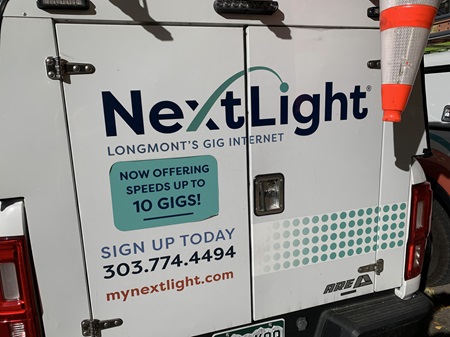
Longmont Nextlight Truck

“NextLight currently passes about 90 percent of the 47,000 premises in Longmont,” NextLight’s Scott Rochat told ILSR. “So at present, we serve about two-thirds of those homes and businesses. We’re delighted to see that so many in the community have chosen to make NextLight their choice for internet service, and we keep welcoming more.”

Last year, Rochat told ILSR the network passed 42,000 premises and was seeing a 64 percent take rate in Longmont.

The network has been so popular locally that officials have pushed the fiber network into neighboring areas, funded exclusively by subscriber revenues and money set aside for capital projects, with no bonding or other supplementary funds involved.

CBRS Spectrum: A Potential Boon To Community Broadband

Recent federal government efforts to expand use of public Citizens Broadband Radio Service (CBRS) spectrum could be of significant help to municipalities and local communities looking to bridge the digital divide with the increasingly popular wireless technology.

CBRS spectrum refers to 150 MHz of spectrum in the 3.5 GHz band. In 2015, the FCC adopted rules for shared commercial use of the band, creating a three-tiered structure to avoid interference with military radar during collaborative use of the spectrum.

For municipalities, the spectrum has already proven to be a valuable way to deploy wireless access to the public. In Syracuse, New York, the city last fall launched a new public wireless network on the back of CRBS. In Longmont, Colorado, the St. Vrain Valley School District used CBRS to build a private LTE network connecting 4,000 students in partnership with NextLight, which operates Longmont's city-owned municipal fiber network.

Not all community deployments of CRBS have delivered satisfactory results for municipalities, however. The STEM Alliance in Westchester County, New York retired their efforts to deploy a CBRS network in Yonkers after they struggled with urban capacity constraints and low usage.

NextLight in Longmont, Colorado Expands Beyond City Borders

Since it first broke ground in 2014, Longmont, Colorado’s community-owned NextLight fiber network has won numerous awards and inspired countless communities nationwide.

With its citywide deployment nearing completion, and counterproductive state legal restrictions in the rear view mirror, city leaders are now working to expand the network beyond city limits.

City officials tell ILSR that network construction has now crossed north of Colorado Highway 66, outside of city limits and into the Anhawa and Strawberry Circle neighborhoods. The extension will bring service to around 125 homes that previously had access to Longmont electrical utility service, but not broadband.

Longmont officials say this latest expansion is being financed entirely by subscriber revenues and money set aside for capital projects, with no bonding or other supplementary funds involved.

Image
Longmont Nextlight Building

“We’ve been carefully evaluating our opportunities for expansion in order to make best use of the community’s resources,” NextLight’s Scott Rochat told ILSR. “Our total investment in this project is just under $300,000; based on our typical rate of adoption, we expect to see about a five-year payback. This also has the benefit of giving us a foothold on the north side of (Highway) 66 to help facilitate more expansion in the future.”

Longmont’s NextLight Wins Top Spot In PC Magazine’s Readers’ Choice Award

Longmont, Colorado’s NextLight community fiber network isn’t just delivering fast and affordable fiber access to locals, it’s consistently winning awards nationwide.

The city-owned network has topped PC Magazine’s Readers’ Choice rankings, which asked readers to rate their satisfaction with their residential broadband providers. Nextlight was also rated as the top gaming ISP of 2023, and was rated the fastest ISP in the nation in 2018 and the second fastest ISP by the magazine last year.

The city was also rated the 17th best work-at-home city in another 2022 survey. This latest survey asked magazine readers to assess ISP satisfaction based on speed, reliability and value. NextLight excelled at all three.

“NextLight's near-perfect scores, including an astronomic 9.9 for overall satisfaction, are unprecedented in the history of PCMag's surveys of ISPs,” the magazine noted. “The company's lowest score is for setup, and yet that number is still higher than almost any other rating earned by another ISP in any category.”

More Supply Than We Need, Municipal Wins in Colorado and Maryland, and FCC Mapping Failures | Episode 73 of the Connect This! Show

Connect This

Join us Wednesday, June 7th at 5pm ET for the latest episode of the Connect This! Show. Co-hosts Christopher Mitchell (ILSR) and Travis Carter (USI Fiber) will be joined by regular guests Kim McKinley (UTOPIA Fiber) and Doug Dawson (CCG Consulting) to talk about all the recent broadband news that's fit to print. 

Email us at [email protected] with feedback and ideas for the show.

Subscribe to the show using this feed or find it on the Connect This! page, and watch on LinkedIn, on YouTube Live, on Facebook live, or below.

Remote video URL

Boulder, Colorado Gets Ready to Roll on Citywide Fiber Network

With the construction of its 65-mile dark fiber backbone nearly complete, city officials in Boulder, Colorado are now ready to move into the next phase of their plan: test the waters for a partnership with private or nonprofit Internet service providers (ISPs) to build out a citywide fiber network to deliver last mile service to the city’s 104,000 residents and businesses.

Last week, the city issued a Request for Information (RFI) “to gauge the interest of for-profit and nonprofit entities in forming a public–private partnership (PPP) with the city to make Gigabit per second-class bandwidth available to all Boulder homes and businesses.”

“As we prepare for further City Council discussion on a future community broadband operating model, it is imperative that we understand the market potential for a PPP (public-private partnership) to meet the city’s goals related to connectivity. We look forward to responses that consider a variety of business models to share technological and operational responsibilities and financial risk with the city in innovative ways,” Innovation and Technology Deputy Director Mike Giansanti said in a press statement when the RFI was issued.

The city is looking for a partner or partners that will come to table with new ideas, create competition, and either fully fund or share costs.

Having prioritized a city-wide fiber-to-the-home (FTTH) build, city officials have identified two main goals: serve the growing demand for “affordable, reliable, and sophisticated broadband technology; and support a thriving business environment.”

Responses to the RFI are due by May 19 at 4 pm MDT.

City officials say they will consider a range of construction and operation designs as well as a variety of ownership models as the City Council will likely vote on the path forward and the execution of a contract sometime this year.

New Bill Could Make Colorado Friendly State for Municipal Broadband

Earlier this month, a new Colorado bill was introduced that, if passed, would rid the state of a law designed to protect monopoly Internet service providers (ISPs) from competition.

SB-183, titled “Local Government Provision Of Communications Services,” seeks to gut a law Big Telecom pushed state lawmakers to pass in 2005. That law, known as SB-152, prevented any of Colorado’s 272 municipalities from building and operating their own telecommunication infrastructure unless local voters first passed a referendum to “opt out.”

End of ‘the Qwest Law’?

Known also as “the Qwest law,” Qwest (now Lumen but more recently CenturyLink), with the help of Comcast, leaned on legislative allies to pass SB-152 to protect their monopoly profits. On our Community Broadband Bits podcast, Ken Fellman and Jeff Wilson, prominent telecom attorneys, recount how lobbyists for the monopoly ISPs were instrumental in pushing two false, but effective, narratives we’ve seen many times before: that SB-152 only sought to “level the playing field” so that private companies could compete with municipally run networks, and that SB-152 “protected” Coloradoans from irresponsible local governments, as if there were no such things as local elections.

But, if passed, the new proposed legislation (SB-183) – co-sponsored by a bipartisan-ish group of state legislators (10 Democrats and 2 Republicans) – would neuter SB-152 and allow local communities to decide for themselves if they wanted to pursue municipal broadband without needing special permission from the state.

PCMag Fastest ISPs 2022: Municipal Broadband and Local ISPs Outperform Major ISPs Once Again

For the past four consecutive years, community owned and/or operated broadband infrastructure has proven to be a key ingredient in the makings of some of the fastest Internet Service Providers (ISPs) in the nation.

As was the case last year, PCMag’s recently released Top 10 list of “The Fastest ISPs of 2022” feature operators that are either municipal broadband networks or use city-owned fiber or conduit to deliver service across whole or parts of their footprint (with the exception of this year’s ninth-place finisher). Another way of saying that is: not one of 10 fastest networks in the nation are owned or operated by the major national ISPs, many of whom have embarked on an aggressive lobbying campaign to misinform public officials in particular and the public in general on the viability and successes of municipal broadband and local partnerships.

After ranking the major ISPs in their own slower category, PCMag turns to “talk about real speed.” 

For that, you don’t go to the big guys … Higher speeds are found in smaller, localized ISPs.

Need for Speed? Look to Local ISPs and Munis

After PCMag compiled a year’s worth of speed tests to analyze which ISPs offer the fastest download and upload speeds, Sonic – a California-based independent ISP – came out on top this year, having “posted the highest number we have ever seen in our test results. Because the uploads this company offers are, on average, eclipsing download speeds—by a lot.”

Catapulting to the top of this year’s list (from 10th place last year), Sonic is a privately-owned company that uses publicly owned conduit in Brentwood, California.