
Coos-Curry Electric Cooperative

Content tagged with "Coos-Curry Electric Cooperative"

Related Topics
Displaying 1 - 4 of 4

Oregon’s Coos-Curry Cooperative Passes 5000th Fiber Customer Milestone

Oregon’s Coos-Curry Electric Cooperative just connected its 5,000th customer, marking a major milestone in the Oregon cooperative’s five-year-effort to bring affordable fiber access to rural state residents long stuck on the wrong side of the digital divide.

The recent celebration of the milestone, documented by the Curry Coastal Pilot, featured a homeowner whose recent fiber connection came 80 years after the same cooperative first connected the home for electrical service.

First created in 1939, the Coos-Curry Cooperative is one of over 200 U.S. electrical cooperatives leveraging their century-old experience in rural electrification to bring affordable fiber access to long-neglected parts of the country – markets that in most cases were left behind by regional telecom monopolies disinterested in improving affordable access.

The cooperative’s fiber wing, dubbed Beacon Broadband, was first launched back in 2021, and offers locals fiber optic broadband at three tiers of service: a symmetrical 500 megabit per second (Mbps) tier for $50 a month; a symmetrical 1 gigabit per second (Gbps) tier for $85 a month; and symmetrical 2 Gbps tier for $120 a month.

Unlike many regional Oregon private telecom monopolies, Coos-Curry Electric Cooperative’s fiber tiers don’t feature usage caps, long-term contracts, or hidden fees.

Sherwood, Oregon Ferments ‘Future-Proof’ Fiber To Preserve and Expand Municipal Network

In the City of Sherwood, a mostly residential bedroom community 16 miles south of Portland, officials have been quietly cultivating a digital vineyard across Oregon’s “Gateway to Wine Country.”

As part of its on-going work to build out a citywide fiber network, Sherwood Broadband recently secured a $9 million grant from the Oregon Broadband Office Broadband Deployment Program (BDP) to continue expanding Sherwood’s municipally-owned network into neighboring rural communities just outside city limits.

The grant award is part of $132 million in federal Rescue Plan funds the state is doling out to an array of community-owned broadband initiatives for 16 projects across 17 counties.

Award winners include Beacon Broadband, a subsidiary of the Coos-Curry Electric Cooperative ($19.4 million); Jefferson County ($19.2 million); Douglas Fast Net, a wholly-owned subsidiary of the Douglas Electric Cooperative ($8.5 million); the Idaho-based member-owned cooperative Farmers Mutual Telephone Company, which offers broadband service in Malheur County, OR ($18.9 million); and a handful of independent providers like Blue Mountain Networks ($6.5 million) and Ziply Fiber ($10.2 million), recently acquired by Bell Canada.

One Cooperative in Oregon Hopes Broadband Will Help Revitalize A Community's Economy - Episode 472 of the Community Broadband Bits Podcast

On this week's episode of the Community Broadband Bits Podcast, ILSR's Senior Reporter, Editor, and Researcher Sean Gonsalves, along with Senior Researcher and Multimedia Producer Maren Machles, chat with Paul Recanzone, the general manager of Beacon Broadband, about Beacon's plan to build out broadband where no one has before. 

Beacon Broadband is a wholly-owned subsidiary of Coos-Curry Electric Cooperative, which has been serving electricity to parts of Coos and Curry counties for the last 80 years. In April 2021, the cooperative broke ground on a fiber-to-the-home network that promises to serve the more than 20 percent of cooperative members who don't have broadband. 

The three discuss the impetus for the project, as well as hopes for the network's impact on the economy and community as a whole. 

This show is 30 minutes long and can be played on this page or via Apple Podcasts or the tool of your choice using this feed

Transcript below. 

We want your feedback and suggestions for the show-please e-mail us or leave a comment below.

Listen to other episodes here or view all episodes in our index. See other podcasts from the Institute for Local Self-Reliance here.

Thanks to Arne Huseby for the music. The song is Warm Duck Shuffle and is licensed under a Creative Commons Attribution (3.0) license.

Oregon Cooperative Promises to Build Where No One Else Will

An electric cooperative in Oregon is once again answering the call, fulfilling unmet needs for those living in places considered by monopoly providers as being unreachable and unlucrative. Coos-Curry Electric Cooperative (CCEC) broke ground last month on the construction of the Beacon Broadband Fiber-to-the-Home (FTTH) network, launching a project that will connect businesses and residents that have historically been left behind when it comes to broadband investment.

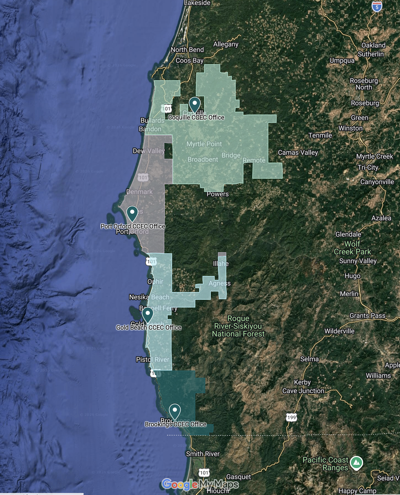
The project is estimated to cost $60 million, running more than 1,400 miles of fiber across Coos-Curry Electric’s service territory. The buildout time is anticipated to take three to four years.

Expanding the Economy Through Reinvestment

Coos County used to be one of the leading contributors to the growing timber industry in the early 1900s, and for a long time had a thriving fishing industry, both of which fueled the local economy. Today, the service sector and tourism drive the region.

“We will never be a timber economy again,” Paul Recanzone, general manager of Beacon Broadband told ILSR in an interview. “We’ve got to find a way to be a 21st century economy . . . we’re going to do tourism, we’re going to do work from home, we’re going to do artisan crafts where the artisans can demonstrate their wares on the Internet.”

CCEC was founded in 1939 with it’s first power lines going up in 1940 and spanning 84 miles. Today, 80 years later, it’s serving 13,000 members. As the economy shifted, CCEC saw the need for residents and emerging businesses to have reliable Internet access. But 20 percent of CCEC members received inadequate satellite or DSL Internet service.

Image

In response CCEC created Beacon Broadband, a for-profit subsidiary of the cooperative, “to build a fiber network where no one else will go,” according to the Beacon Broadband website