
event

Content tagged with "event"

Related Topics
Displaying 1 - 10 of 269

B4DE Reprise: Following the Money on Digital Equity and AI Data Centers
With tax day as a backdrop, the Institute for Local Self-Reliance (ILSR) Community Broadband Networks Initiative and the National Digital Inclusion Alliance (NDIA) convened its quarterly Building for Digital Equity (B4DE) livestream yesterday that shined a light on how public dollars and tax policy intersect with digital equity.

The event – an ongoing series sponsored by UTOPIA Fiber – brought together community organizers, policy experts, and local government leaders on the frontlines of working to expand opportunities for those being left in the digital dust.

What set yesterday's B4DE apart was its featured focus on how the emergence of AI hyperscale data centers are impacting communities and how communities can fight for a better deal.

The Data Center Boom — and Its Costs

MediaJustice Senior Campaign Lead Brandon Forester and Jordana Barton-García, Connect Humanity Director of the Texas Rio Grande Valley Broadband Coalition, heated up the afternoon’s fireside chat with an unflinching look at the rapid expansion of AI infrastructure.

Forester was direct about what's really driving the surge: “The only idea they have left is scale” and warned that data center developers often arrive in communities – particularly in the South –  promising economic benefits that rarely deliver. “They just need your space, they need your resources, and they need you just to let them do what they want to do,” he said.

Forester pushed back on the idea that data centers generate meaningful local tax revenue, noting how in Prince George's County, Maryland, where he lives, the projected annual return from a single data center amounts to roughly $6 million after state tax breaks, which are a fraction of what communities are led to expect.

Barton-García emphasized how communities have more power than they realize – but only if they act early. Her core message: get to the negotiating table before the deal is done.

On Tax Day, Advocates Spotlight How Local Tax Dollars Can Close the Digital Divide and Hold AI Data Centers Accountable

As Americans file their taxes this Tax Day, digital equity leaders across the nation will gather for a timely exploration of how public dollars are being used to strengthen communities – and how local advocates can negotiate better deals as AI data centers rapidly expand, lured with tax breaks.

Co-hosted by the Institute for Local Self-Reliance Community Broadband Networks Initiative and the National Digital Inclusion Alliance (NDIA), the next Building for Digital Equity (B4DE) livestream promises to offer insights from frontline forces working to ensure broadband and technology investments serve public needs rather than distant corporate interests.

With the series sponsored by UTOPIA Fiber, the upcoming B4DE livestream – “Local Dollars, Local Solutions: Digital Equity Tax Money & How to Negotiate Better AI Data Center Deals” – is slated for April 15 at 3 p.m. ET and will bring together national policy experts, local leaders, and community advocates working in the trenches of digital inclusion.

Registration is now open here.

“Tax day should serve as a reminder that public money should work for the public,” organizers said. 

“Communities are asking how to use their tax dollars to expand access to the Internet, digital skills, and devices – and how to effectively negotiate, or in some cases, stop data center developers from harming or extracting wealth from cities and towns without public benefit.”

The agenda for the free event will include a brief framing conversation before kicking things off with a creative segment highlighting the power of artistic collaboration and community storytelling, underscoring how digital access supports cultural expression and civic life.

ILSR and AAPB Webinar Shines Light on Connecting Multi-Family Housing

Closing the digital divide where it's most dense – inside multi-family housing – took center screen during yesterday's webinar hosted by the Institute for Local Self-Reliance Community Broadband Networks Initiative and the American Association for Public Broadband (AAPB).

Co-host and AAPB Executive Director Gigi Sohn framed the discussion as a new way of thinking about universal broadband access. 

"If you want to connect a community, we can’t just think street by street. We have to also think floor by floor, building by building," Sohn said. 

"Apartment complexes, public housing, condos, and mobile home parks contain some of the largest concentrations of unserved and underserved households in the country. These buildings should be cost-efficient to serve, but in reality they often present some of the toughest barriers – from wiring challenges and access restrictions to exclusive provider agreements and outdated policies."

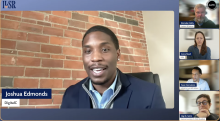
The webinar, "High-Density, High Impact: Connecting Apartment Buildings, Public Housing and Multi-Dwelling Units," featured Cleveland-based DigitalC CEO Joshua Edmonds; REVinternet founder and CEO Brendan Kelly; and Anna Read, a Principal with the national consulting firm HR&A.

The conversation ranged from why MDU's matter to the business and technical realities of providing Internet access to those who live in them; as well how federal and state policies have helped or hindered the push to ensure everyone has the ability to meaningfully participate in a digital world.

Watch the webinar in its entirety below:

Event: High Density, High Impact - Connecting Apartment Buildings and Public Housing

Today at 12pm ET/11am CT, ILSR and the American Association of Public Broadband co-host an event aimed at tackling the digital divide in a realm rife with both challenges and opportunities: apartments, public housing, and multi-dwelling units. 

Co-hosted by AAPB’s Gigi Sohn and ILSR’s Community Broadband Networks’ Associate Director for Communications Sean Gonsalves, they will be joined by Cleveland-based DigitalC CEO Joshua Edmonds; REVinternet founder and CEO Brendan Kelly; and Anna Read, a Principal with the national consulting firm HR&A who previously worked on broadband funding at the U.S. Treasury Department and also with several states in establishing programs to help connect public housing residents.

This event is free to register.

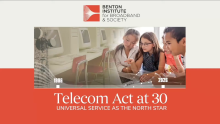
Thirty Years Later, the Telecom Act’s Legacy Remains Unfinished

When Congress passed the Telecommunications Act of 1996, it sought to foster innovation and competition in telecommunications markets, expand the definition of universal service, and modernize regulatory structures for the digital age. Three decades later, architects of the ‘96 Act say it achieved many of those goals, but numerous legal challenges following its passage reshaped how key provisions were implemented.

“Litigation shaped so much of what the Act eventually became,” said Mignon Clyburn, a former commissioner of the Federal Communications Commission, speaking Thursday among a panel of former FCC regulators, legal counsel, and policy advisors who helped shape and defend the landmark telecom law.

Gathered for an event organized by the Benton Institute for Broadband & Society marking the law’s 30th anniversary, the event reflected on both the spirit and letter of the landmark legislation which has shaped much of the modern Internet in the United States. The first major overhaul of telecommunications law in more than 60 years, the ‘96 Act required the FCC to conduct more than 80 separate rulemakings addressing everything from appropriate pricing, to interconnection rules and the unbundling of incumbent telephone networks.

Where the Digital Divide Is Densest: Why Universal Internet Access Runs Through Apartment Buildings

On paper, it’s cheaper to connect densely-clustered residences. But, as many as 4.3 million households inside apartment, condo, and mobile-home complexes do not have Internet access – either because the service is unaffordable or because the building has antiquated wiring.

Given the importance of Internet access for meaningful participation in a digital economy – and because universal access to high-speed Internet has cascading community benefits that not only save subscribers and municipalities money, but also improve health outcomes – more cities and towns are looking to ensure high-performance Internet access is available in what industry insiders call “multi-dwelling units” (MDUs).

Next week, the increasingly popular webinar series hosted by the Institute for Local Self-Reliance (ILSR) Community Broadband Networks initiative and the American Association of Public Broadband (AAPB) will dive into the challenge head-on with a focus on how local communities can better serve the places where the largest numbers of disconnected Americans are clustered.

The free webinar – “High-Density, High Impact: Connecting Apartment Buildings, Public Housing and Multi-Dwelling Units” – is slated for March 19 from noon to 1 pm ET.

Registration is now open here.

“Most of the federal government’s funding focus for building new networks is targeted at sparsely populated rural areas. But the fact is: apartment buildings – especially those living in public housing in urban and suburban settings – represent large concentrations of unconnected or underconnected households,” AAPB Executive Director Gigi Sohn said. 

AAPB and ILSR to Host Webinar on Legal Challenges Facing Community Broadband

Cities and towns building or expanding locally owned broadband networks can face a complex and confusing legal landscape.

To help local leaders better understand those challenges, the American Association for Public Broadband (AAPB) and the Institute for Local Self-Reliance (ILSR) Community Broadband Networks Initiative are kicking off the new year with another one of their increasingly popular and informative webinars.

The free event, “Navigating the Legal Landscape of Community Broadband” is slated for Tuesday, January 20, from 12 to 1 p.m. ET.

Registration is now open here.

It will feature Sean Stokes and Casey Lide, attorneys with noted law firm Keller & Heckman. They have advised communities across the country on the legal, regulatory, and governance issues associated with community broadband projects.

The session will focus on the most pressing legal considerations facing both communities exploring broadband for the first time and networks that have already been built but are navigating next-stage challenges such as expansion, partnerships, and compliance.

“Too often, communities assume broadband challenges are primarily technical or financial, when in some instances legal and regulatory issues can determine whether a project succeeds or fails,” said Sean Stokes, partner at Keller & Heckman. 

“Our goal is to help communities understand where their legal authority comes from, what risks they should anticipate, and how thoughtful planning early on can prevent costly problems down the road.”

The webinar will cover a range of topics, including state laws that restrict or condition municipal broadband, governance and ownership models, partnerships with independent private Internet service providers, financing and funding compliance, regulatory and operational challenges, and litigation risks communities may face.

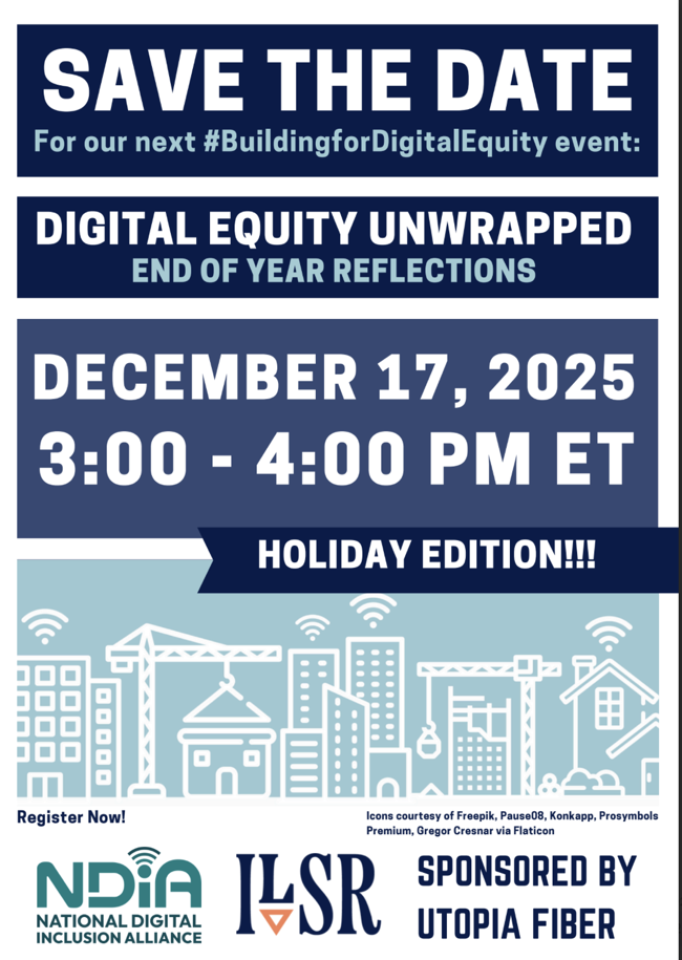
Digital Equity Unwrapped: A Look Back at a Challenging Year – and the Hope That Remains

The end of the year may be winding down, but the digital equity community is gearing up for one last big Building for Digital Equity (#B4DE) gathering.

Digital Equity Unwrapped” – a special livestream bringing together advocates and broadband-for-all leaders who spent 2025 pushing for a more connected and inclusive nation – is slated for Wednesday, December 17, beginning at 3 pm ET.

Registration is available here.

Co-hosted by the Institute for Local Self Reliance (ILSR) Community Broadband Networks Initiative and the National Digital Inclusion Alliance (NDIA), the final #B4DE of the year will open with a look ahead at Net Inclusion 2026, coming to Chicago this February.

Image
B4DE End of Year 2025

A special gift-wrapped part of the #B4DE line-up will feature Kyla Williams Tate, who will share original poetry grounded in digital equity, reminding us that connectivity isn’t just about infrastructure – but about the human networks that do the work.

Then, attention will turn to a major focus of 2025 for digital equity proponents: fighting for affordability. For that, Lindsey Skolnik of the California Alliance for Digital Equity (CADE) will take center screen to discuss California’s push for statewide affordable broadband legislation.

Webinar Redux: Why Cities Can’t Afford to Wait on Smart Infrastructure

Two city utility managers, an economist, and a fiber technologist walk into a virtual webinar …

And what followed was a deep dive into why delaying investment in smart city infrastructure is increasingly costly.

The hour-long livestream event  – co-hosted by the Institute for Local Self-Reliance (ILSR) Community Broadband Networks initiative and the American Association for Public Broadband (AAPB) – brought together municipal utility managers, an economist, and a leading fiber technologist to explore how cities can future-proof themselves with digital infrastructure.

Guests who appeared on “Building Smarter Cities and the Cost of Doing Nothing” today emphasized how “smart cities” are built on fiber networks and what city investments in the gold-standard of Internet connectivity can do to boost economic development while improving the quality of life for local residents and businesses.

They highlighted the real costs of inaction, pointing to slower economic growth and lost municipal revenue opportunities as something many cities or towns overlook when thinking about local infrastructure.

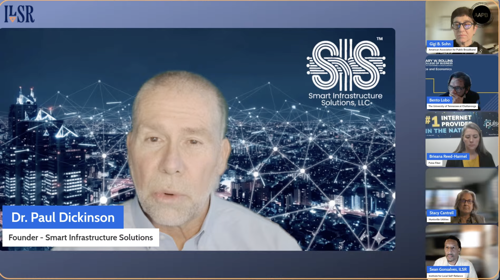
Image
Screenshot of the panelists talking during the webinar

The webinar featured Huntsville Utilities VP of Engineering Stacy Cantrell who provided key insights into the public-private partnership Huntsville Utilities struck with Google Fiber and what it has meant to “Rocket City.”

Another virtual case study was provided by Brieana Reed-Harmel, Broadband Manager for Pulse Fiber, discussing how the city’s fiber network is propelling economic revitalization efforts in Loveland and how the success of the network is now being extended into neighboring communities.

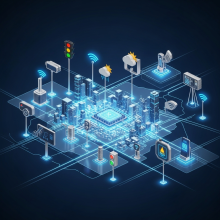
Webinar To Explore ‘Smart City’ Infrastructure and the Costs of Ignoring It

Once again, the Community Broadband Networks team at the Institute for Local Self-Reliance (ILSR) will team up with the American Association for Public Broadband (AAPB) to host another thought-provoking webinar – “Building Smarter Cities and the Cost of Doing Nothing.”

Moderated by AAPB Executive Director Gigi Sohn and ILSR’s Sean Gonsalves, the livestreamed discussion will bring together community-driven broadband champions who are redefining what it means to be a “smart city” — and what communities risk when they fail to invest in modern connectivity.

Slated for November 20th starting at 12 noon ET, interested attendees for the free 60 minute webinar are invited to register now here.

From Huntsville’s groundbreaking public–private partnership with Google Fiber to Loveland’s city-owned-and-operated Pulse Fiber, network operators in those communities will share real-world lessons on how they were able to turn infrastructure into opportunity. 

The livestreamed webinar will feature Stacy Cantrell, Vice President Engineering for Huntsville Utilities; Brieana Reed-Harmel, Broadband Manager for Pulse Fiber; and will also include expert insights from Dr. Bento Lobo (University of Tennessee at Chattanooga) who will unpack the economic data behind smart city investments, while Paul Dickinson (Founder of Smart Infrastructure Solutions) will offer a glimpse into the next generation of intelligent infrastructure.

As the panel dives into the why and how communities are transforming their local digital landscapes, the forum will explore the technologies, policies, and partnerships powering the cities of tomorrow — and why doing nothing is the most expensive choice of all.